Did you know that the Black Rhino isn't actually black at all? This mysterious resident of the African savanna actually has grey skin, and its name comes from a historical misunderstanding! Despite its name, what truly makes this rhino special is its incredible "prehensile" lip, which it uses like a finger to pluck leaves from thorny bushes. But with fewer than 7,000 individuals left in the wild, every single rhino counts. Join us as we explore the habitat, diet, and high-tech protection projects that are keeping this species alive today.
| Common Name | Black Rhino (Tê giác đen / Tê giác môi móc) |
|---|
| Scientific Name | Diceros bicornis |
|---|
| Taxonomy |
Kingdom: Animalia
Phylum: Chordata
Class: Mammalia
Order: Perissodactyla
Family: Rhinocerotidae
|
| Size | 1.3–1.8 m in height at shoulder; 2.8–3.75 m in body length |
|---|
| Weight | 800–1,400 kg |
|---|
| Lifespan | 35–50 years in the wild; up to 50+ years in captivity |
|---|
| Habitat | Tropical and subtropical grasslands, savannas, shrublands, and deserts |
|---|
| Range | Mainly South Africa, Namibia, Kenya, and Zimbabwe (95% of population) |
|---|
| Diet | Herbivorous (Browser); leaves, branches, shoots, and thorny bushes |
|---|
| Conservation Status | Critically Endangered (CR) |
|---|
Physical Characteristics of the Black Rhino
The Black Rhino (Diceros bicornis) is a powerful mammal known for its compact and sturdy build. In terms of size, the Black Rhino is generally larger and heavier than the Javan Rhino found in Asia. While the Black Rhino weighs between 800 kg and 1,400 kg, the Javan Rhino is typically smaller, averaging around 900 kg to 1,500 kg but with a slimmer frame and shorter stature.
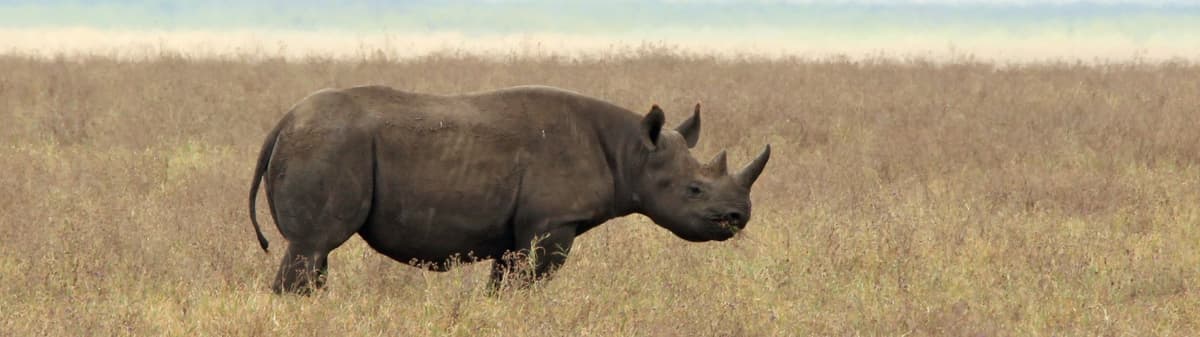
Despite its name, the Black Rhino’s skin is actually dark grey or brown, often changing appearance based on the mud it wallows in. A key identifying feature is its prehensile upper lip, or "hooked lip," which acts like a flexible finger to pluck leaves and twigs from trees. This differs significantly from the Javan Rhino, which also has a pointed lip but a much foldier, "armored" skin appearance.
The Black Rhino possesses two horns made of solid keratin. The front horn is usually much larger, averaging 50 cm but capable of reaching over 130 cm. This is a major distinction from the Javan Rhino, which has only one horn (and females often have none). With keen hearing and a sharp sense of smell, the Black Rhino navigates its environment with its head held high, using its horns as formidable tools for defense and foraging.
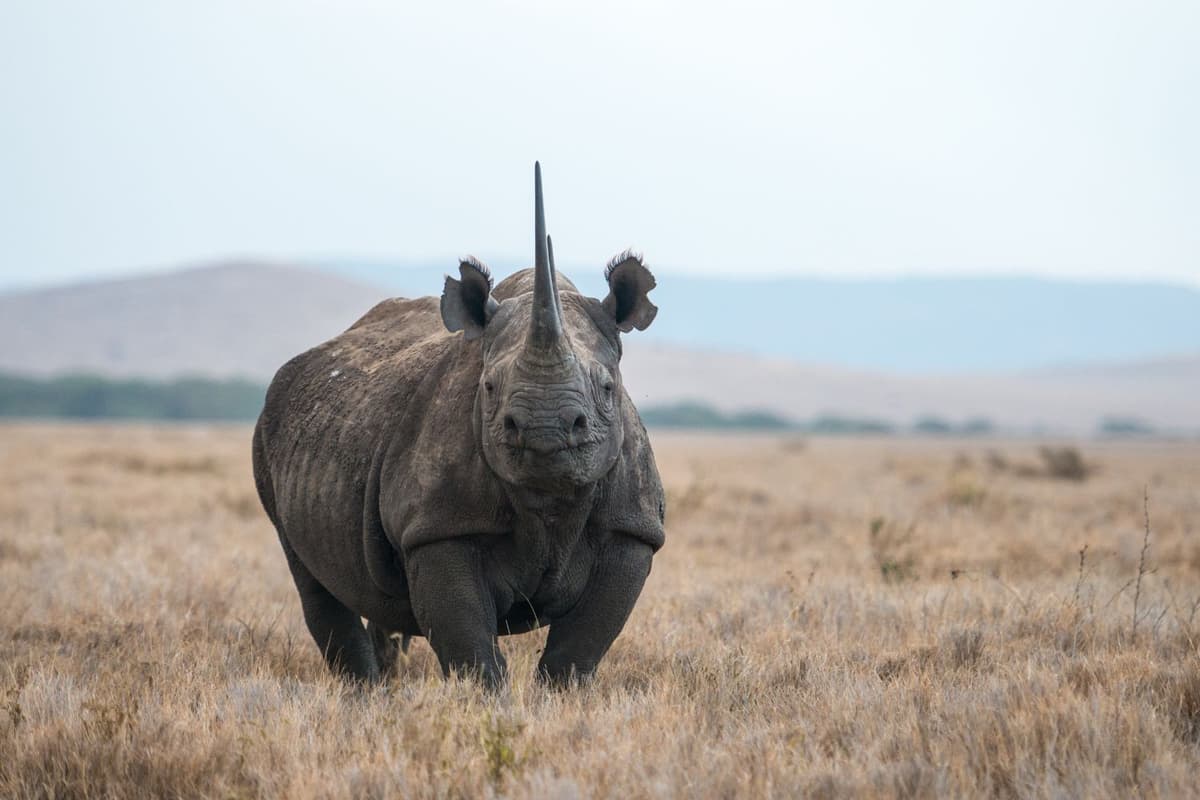
This rhino shows its strong build and iconic horn.
Habitat and Distribution of the Black Rhino
Habitat of the Black Rhino
The Black Rhino is a highly adaptable species that can survive in diverse environments, including savannas, scrublands, woodlands, and even arid semi-deserts. However, their preferred habitat is the transition zone between grasslands and forests, where thick, thorny bushes and acacia trees are abundant.
Black Rhinos typically establish their territories within a 25 km radius of a permanent water source. They need regular access to water not only for drinking but also for wallowing in mud, which helps regulate their body temperature and protects their skin from insects and the sun.
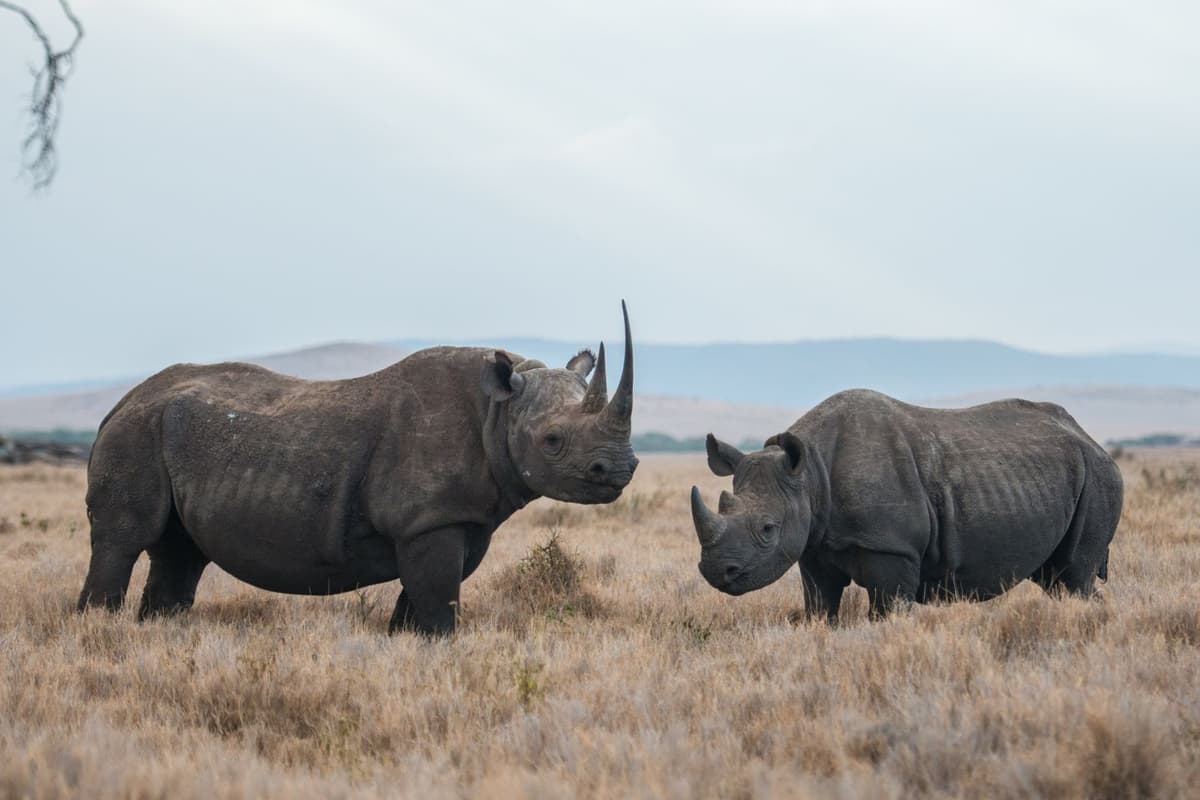
Two rhinos face each other on the grassland.
Distribution of the Black Rhino in Africa
Historically, the Black Rhino was the most numerous rhino species, with hundreds of thousands roaming across almost all of sub-Saharan Africa. Their original range covered vast areas, excluding only the Congo Basin, tropical rainforests, and the Ethiopian Highlands. Today, due to poaching for their horns, they have lost over 98% of this historical range. Their distribution is now severely fragmented, with populations mostly restricted to strictly protected nature reserves and national parks with heavy security.
Currently, Black Rhinos are found in 12 African countries, but the vast majority, about 94% to 95.7% of the entire population, is concentrated in just 4 nations: South Africa, Namibia, Kenya, and Zimbabwe. This tragic decline mirrors the story of the last Javan Rhino in Cat Tien National Park. The Javan Rhino is now officially extinct in Indochina. Today, the world's last 50 to 80 Javan Rhinos are clinging to survival in a single location: Ujung Kulon National Park on the island of Java, Indonesia.
Subspecies of the Black Rhino
The Black Rhino (Diceros bicornis) is divided into several subspecies. While scientists sometimes debate the exact number, the International Union for Conservation of Nature (IUCN) officially recognizes four primary groups. These are categorized based on their body size, skin folds, and the specific regions of Africa they inhabit.
- South-central Black Rhino (D. b. minor): This is the most numerous subspecies alive today. Historically, they roamed from Tanzania down through Zambia, Zimbabwe, and into South Africa. They are known for their compact bodies, relatively large heads, and very prominent skin folds.
- South-western Black Rhino (D. b. bicornis): These rhinos are specialists in surviving harsh, arid environments. They are primarily found in Namibia and parts of South Africa, with occasional sightings in Angola. They are well-adapted to semi-desert conditions.
- Eastern Black Rhino (D. b. michaeli): Once found across Ethiopia, Sudan, and Kenya, their range is now mostly limited to protected areas in Kenya, Rwanda, and Tanzania due to heavy poaching.
- Western Black Rhino (D. b. longipes): This subspecies is a tragic example of extinction. Once widespread across West African savannas in countries like Cameroon and Chad, it was officially declared extinct by the IUCN in 2011 after the last individuals disappeared in 2006.
Beyond the main four, some classification systems list up to 8 subspecies, many of which are now lost or extremely rare:
- Cape Black Rhino: Once common near the Cape of Good Hope, it went extinct around 1850 due to overhunting.
- North-eastern Black Rhino (D. b. brucii): Formerly lived in Sudan and Somalia but became extinct in the early 20th century.
- Chobe Black Rhino (D. b. chobiensis): This group is nearly extinct, with potentially only one individual left in Botswana.
- Uganda Black Rhino (D. b. ladoensis): Originally from Uganda and South Sudan, its current status is unclear, though some may still survive in Kenyan reserves.
Diet and Predators of the Black Rhino
Diet
The Black Rhino is a herbivore, specifically a "browser." This means it eats leaves, branches, and young shoots rather than grazing on grass like the White Rhino. Its diet is very diverse, including over 220 different plant species such as thorny bushes, small trees, legumes, and succulents. They especially enjoy acacia trees and can even eat some plants that are toxic to other animals.
To get its food, the Black Rhino uses its famous "hooked" upper lip. This flexible lip works like a finger, allowing the rhino to grip, bend, and break off woody twigs or pluck leaves with great precision. Sometimes, they even use their strong horns to dig up roots and tubers from underground.
Predators of the Black Rhino
Adult Black Rhinos have almost no natural predators in the wild because of their massive size, thick skin, and deadly horns. Their biggest threat by far is humans, specifically poachers. However, young calves and sub-adults are much more vulnerable. They are often targeted by powerful African predators such as lions, spotted hyenas, leopards, African wild dogs, and Nile crocodiles.
How the Black Rhino Defends Itself
The Black Rhino uses both its physical features and aggressive behavior to stay safe. Its primary weapon is its sharp keratin horn, which it uses to stab or threaten predators and other rhinos. If it feels cornered, the rhino will perform a "charge." It lowers its head and runs directly at the enemy at speeds of up to 55 km/h to strike or trample the threat. Its thick, armor-like skin provides a natural shield against thorns and the claws of predators.
Although its eyesight is poor, the Black Rhino compensates with an incredible sense of smell and very sensitive, tube-shaped ears that can rotate to hear danger from far away. Additionally, rhino mothers are extremely protective. They will fight fiercely to keep their calves safe and often hide their young in secure spots when visiting busy water holes to avoid conflict with aggressive males.
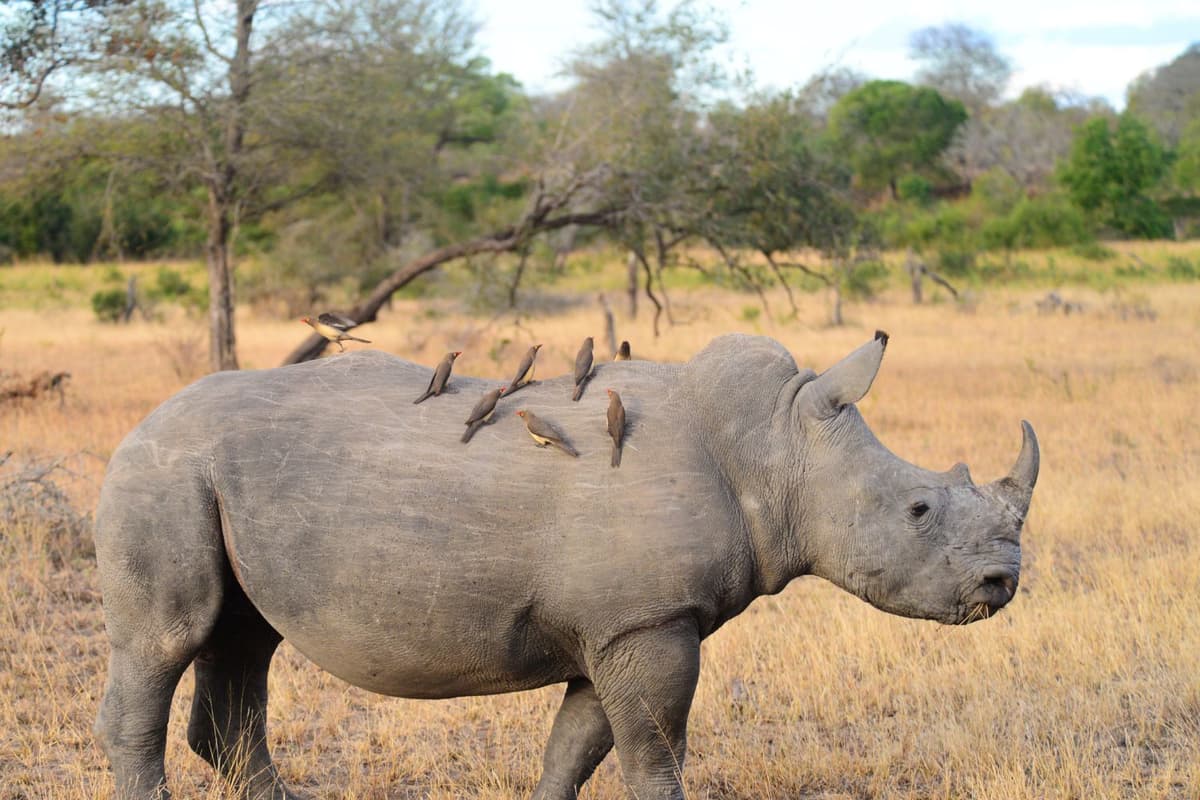
Some birds rest on the rhino, picking off parasites.
Behavior of the Black Rhino
The Black Rhino is often thought of as a lonely animal, but it is actually more social than people realize. The most important social unit is a mother and her calf. While adult males usually live alone and protect their own territory, females often have overlapping home ranges and sometimes travel in small groups called "crashes," especially when gathering at water holes at night.
Black Rhinos are famous for being nervous and aggressive. Because they have very poor eyesight, they often charge at anything they don't recognize, including vehicles, fires, or even termite mounds, just to be safe. This defensive nature leads to many fights; in fact, about 50% of males and over 30% of females die from injuries gained during battles over territory or mates.
To communicate, they rely on their amazing sense of smell. They use communal dung heaps, called "middens," as "message boards" to identify other rhinos. Males will spray urine and scrape their feet in dung to mark their paths, while females use scent to attract mates. They also make various sounds, like loud snorts when angry or high-pitched whines when a calf calls its mother. They are active during the day and night but prefer moving when it is cool. During the hot noon sun, they love to rest in the shade or wallow in mud to protect their skin from the sun and biting insects.
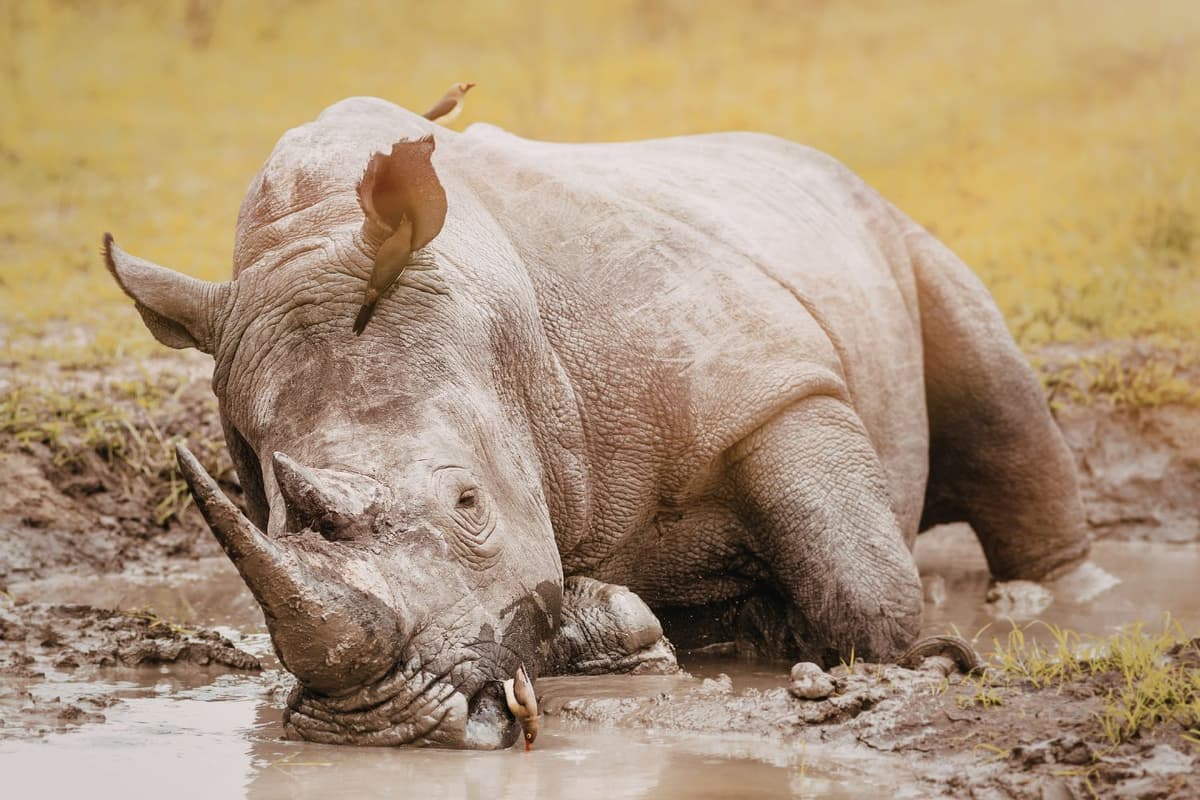
Covered in mud, the rhino cools off under the sun.
Reproduction of Black Rhino
The reproduction of the Black Rhino is a long and careful process. A mother rhino carries her baby for a very long time, usually between 15 and 16 months. When it is time to give birth, she finds a private, hidden spot to deliver a single calf. In the wild, a female typically has a new baby every 2.5 to 4 years, though this can take longer if food is scarce or if the population is under stress. Females are ready to start their own families around age 4 to 7, while males take a bit longer to mature, usually around 7 to 10 years old.
When a baby Black Rhino is born, it weighs between 30 and 50 kg and has no horns yet. Even though they are small, these calves are amazing. They can stand up and start walking within just an hour or two. They begin nursing almost immediately, but they also have a unique habit: they eat their mother's dung during their first few months. This might sound strange, but it helps their young stomachs grow the healthy bacteria needed to digest tough plants later in life.
A Black Rhino calf is very well-protected and always walks right behind its mother for safety. Unlike some other rhinos, the mother is extremely fierce and will fight off lions or hyenas to keep her baby safe. The calf stays close to its mother for 2 to 4 years, learning how to survive in the wild. They only leave to find their own territory when the mother is ready to give birth to a new sibling.
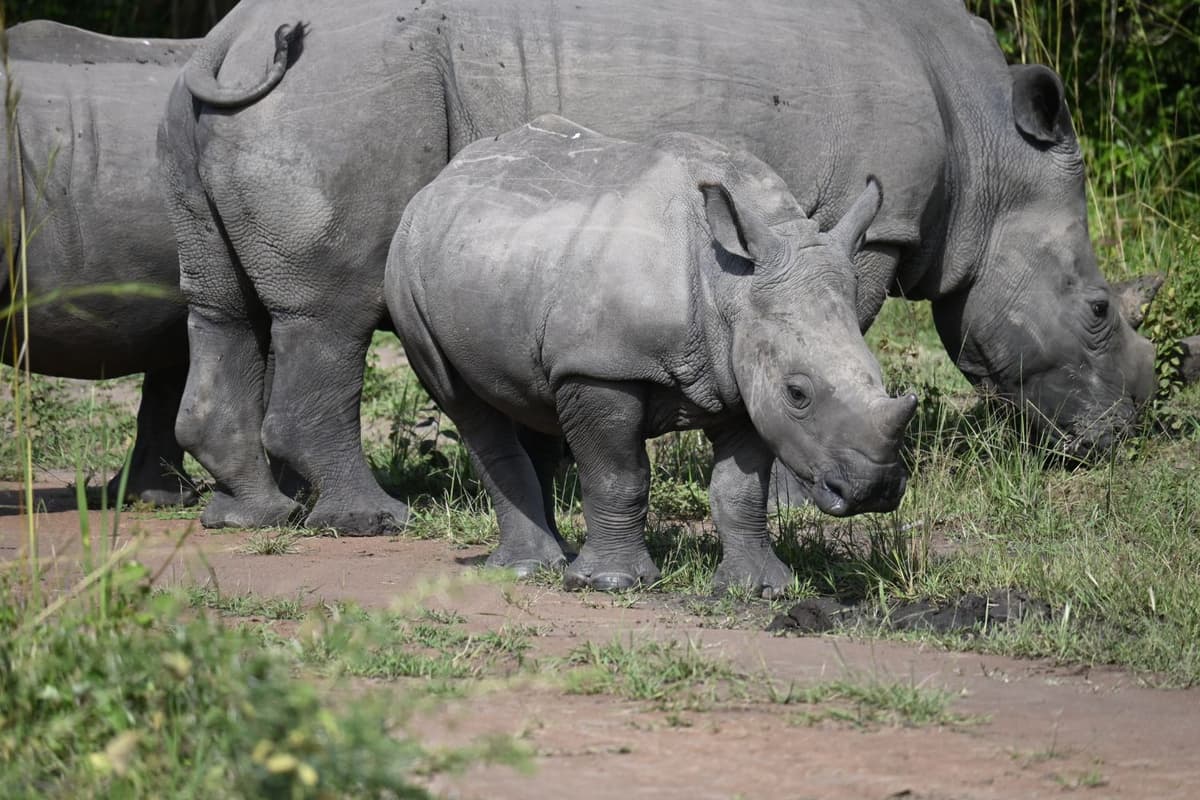
A small group of rhinos stays close together.
Threats and Conversation
Conservation Status of the Black Rhino
The Black Rhino is currently classified as Critically Endangered by the IUCN. While its population faced a devastating collapse in the past, recent data from early 2026 shows encouraging signs of recovery.
As of 2025, there are approximately 6,788 Black Rhinos living in the wild across 12 African countries, marking a 5.2% increase from 2022. This is a significant victory compared to the mid-1990s when the population hit an all-time low of only about 2,300 individuals.
Today, about 95% of these rhinos are concentrated in South Africa, Namibia, Kenya, and Zimbabwe.
Threats to Survival
The greatest threat to the Black Rhino remains illegal poaching for its horn, driven by high demand in Asian markets like China and Vietnam due to unproven medicinal beliefs and its status as a symbol of wealth. Between 1970 and 1990, poaching wiped out nearly 98% of the global population.
Although poaching rates have slightly decreased, with South Africa reporting 352 incidents in 2025 compared to 420 in 2024, the danger is still constant. Other major threats include habitat loss from agriculture and mining, which fragments populations and reduces genetic diversity.
Additionally, climate change is turning essential woody brushlands into grasslands, while historical political instability in African nations has often disrupted protection efforts.
Conservation Projects and Success Stories
Modern conservation has turned the tide through innovative biological management and technology. Kenya has doubled its rhino population since the 1980s, with the Ol Pejeta Conservancy reporting zero poaching incidents since 2017 thanks to AI-powered thermal cameras.
In South Africa, the WWF Black Rhino Range Expansion Project now protects 16% of the country’s population across 17 reserves. Another effective, though drastic, method is controlled dehorning. This practice, combined with GPS tracking chips hidden in the horn base, reduced poaching by 78% in the Greater Kruger region between 2017 and 2023. These high-tech solutions, alongside community engagement, provide a roadmap for the species to reach future growth targets.
5 Interesting Facts about The Black Rhino
- The Black Rhino is actually grey or dark brown and got its name from a language misunderstanding rather than its real skin color.
- A young Black Rhino eats its mother's dung to get the healthy bacteria needed to digest plants as it grows up.
- The Black Rhino has a special pointed upper lip that works like a finger to grab and pull leaves from thorny bushes.
- The Black Rhino has very poor eyesight but uses its amazing sense of smell and rotating ears to detect danger from far away.
- The Black Rhino lives with small birds called oxpeckers that eat parasites off its skin and scream to warn the rhino of nearby enemies.
Reference
- Boy, S. C., Raubenheimer, E. J., Marais, J., & Steenkamp, G. (n.d.). White rhinoceros Ceratotherium simum horn development and structure: A deceptive optical illusion.
- Chanyandura, A. (2020). Local community participation in rhino conservation - Key to conservation success. Research in Ecology, 2(3), 10-12. https://doi.org/10.30564/re.v2i3.2349
- Chimes, L. C., Beytell, P., Muntifering, J. R., Kötting, B., & Neville, V. (2022). Effects of dehorning on population productivity in four Namibia sub-populations of black rhinoceros. European Journal of Wildlife Research, 68(5), 58. https://doi.org/10.1007/s10344-022-01607-5
- Freeman, E. W., Meyer, J. M., Adendorff, J., Schulte, B. A., & Santymire, R. M. (2014). Scraping behavior of black rhinoceros is related to age and fecal gonadal metabolite concentrations. Journal of Mammalogy, 95(2), 340-348. https://doi.org/10.1644/13-MAMM-A-059
- Law, P. R., Jewell, Z. C., & Alibhai, S. K. (2018). Disassociation between black rhinoceros mothers and their calves. African Journal of Ecology. https://doi.org/10.1111/aje.12582
- Muntifering, J. R., Guerier, A., Beytell, P., & Stratford, K. (2023). Population parameters, performance and insights into factors influencing the reproduction of the black rhinoceros in Namibia. Oryx. https://doi.org/10.1017/S0030605322001065
- Pilgrim, M., & Biddle, R. (2020). EAZA best practice guidelines for the black rhinoceros (2nd ed.). https://doi.org/10.61024/BPG2020BlackRhinocerosEN
- Renner, M. J., Kohn, K., Olds, J. E., & Freeman, K. (2021). Behavioral and physical development of captive–born eastern black rhinoceros calves. Journal of Applied Animal Welfare Science. https://doi.org/10.1080/10888705.2021.1912606
- Santymire, R., Meyer, J., & Freeman, E. W. (2012). Characterizing sleep behavior of the wild black rhinoceros. Sleep, 35(11), 1569-1574. https://doi.org/10.5665/sleep.2212