If there were an award for the most adaptable bird on the planet, the Common Myna would likely take the gold. With its bold yellow eye patches and a walk that looks more like a proud strut, this member of the starling family is famous for more than just its looks. It is one of the most intelligent birds in the world, capable of mimicking human speech and even car alarms with startling accuracy.
In this article, we’ll dive into its unique social behaviors, its amazing vocal talents, and why it has become such a dominant force in ecosystems globally.
| Common Name | Common Myna |
|---|
| Scientific Name | Acridotheres tristis |
|---|
| Taxonomy |
Kingdom: Animalia
Phylum: Chordata
Class: Aves
Order: Passeriformes
Family: Sturnidae
|
| Size | 23–26 cm in length; Wingspan 120–142 mm |
|---|
| Weight | 82–143 grams |
|---|
| Lifespan | Average 4 years in the wild; 12+ years in captivity |
|---|
| Habitat | Open woodlands, grasslands, agricultural fields, and urban areas |
|---|
| Range | Native to Asia; Invasive in Australia, Africa, North America, and Pacific Islands |
|---|
| Diet | Omnivorous; insects, fruits, nectar, small reptiles, and food scraps |
|---|
| Conservation Status | Least Concern (LC) (Global population is increasing) |
|---|
Physical Appearance and Lifespan
The Common Myna (Acridotheres tristis) is a sturdy bird, measuring 23–26 cm in length and weighing up to 143 grams. It is easily identified by its chocolate-brown body, glossy black hooded head, and bright yellow bill and legs. A signature feature is the bare, yellow patch of skin behind its eyes. While both sexes look nearly identical, males are often slightly larger.
In flight, striking white wing patches and white-tipped tails are visible, though these tail tips wear down during the breeding season. The eyes hold fascinating details, with adult irises varying from brown to red and filled with tiny silvery-white dots like "stars." Juveniles have simple grey irises. Their plumage also shows subtle beauty, with purple-brown tones on the back and breast, and a creamy white under-tail area.
Juveniles differ during their first few weeks; their facial skin is white rather than yellow, and they lack the distinctive white tail tips. A great way to identify a Myna from a distance is by its confident posture. Unlike most birds that hop, the Myna has a characteristic "strut" or walking gait on the ground.
Geographically, these birds follow Gloger’s Rule; those in drier Northwest India are paler, while the Sri Lankan subspecies is much darker with larger yellow cheek patches. In the wild, they average a 4-year lifespan, which can extend to over 12 years in captivity.
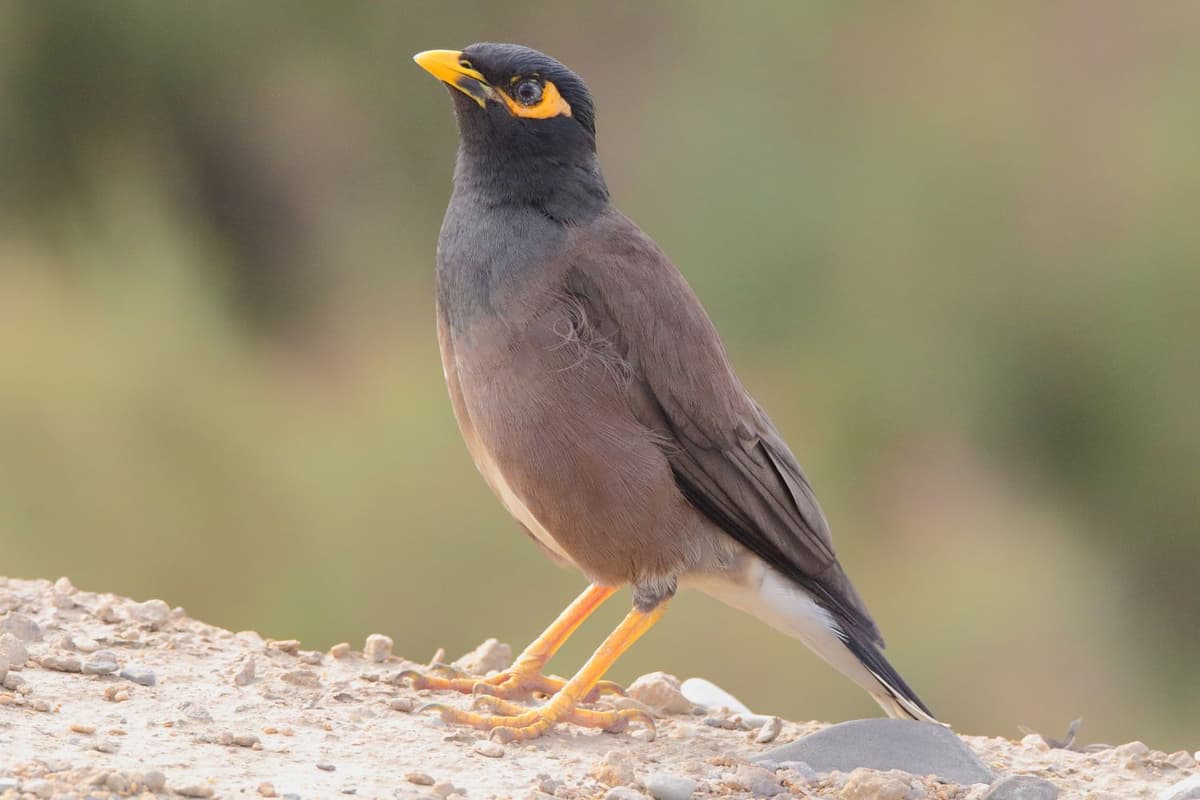
The bird displays its sleek body and bright yellow eye patch.
Habitat and Distribution of the Common Myna
The Common Myna is one of the most adaptable birds in the world. In nature, it prefers open woodlands, grasslands, and agricultural fields, usually avoiding thick, dense forests. These birds can live at various altitudes, from coastal areas up to 3,000 meters high in the Himalayas.
A key trait of the Myna is that it loves living near humans (synanthropic). They thrive in cities and suburbs where they can find food scraps and nesting spots in man-made structures like roof gaps, pipes, and vents. In the wild, they typically nest in tree hollows or rock crevices.
Native Range of the Common Myna
The original home of the Common Myna covers a vast area across Asia and the Indian subcontinent. Its native range includes:
- South Asia: India, Pakistan, Nepal, Bhutan, Bangladesh, and Sri Lanka.
- Central & West Asia: Iran, Afghanistan, Uzbekistan, Tajikistan, and Turkmenistan.
- Southeast Asia: Myanmar, Thailand, Singapore, Malaysia, and the Indochinese peninsula (including Vietnam).
- East Asia: Parts of China and Japan.
Invasive Range and Environmental Impact
The Common Myna is famous for being a highly successful—and dangerous—invader. The IUCN lists it as one of the 100 worst invasive species in the world. Because humans introduced them to new areas, they now threaten local ecosystems globally:
- Australia: They are nicknamed "flying rats" because they spread rapidly along the East Coast and steal nesting spots from native birds.
- Africa: They are invading South Africa, particularly Kruger National Park, and Madagascar.
- Americas & Pacific: They have established large populations in Hawaii, Florida, New Zealand, and Fiji, where they compete with local wildlife for food.
- Other regions: They are also considered pests in parts of Europe (Spain, Portugal), Israel, and many islands in the Atlantic and Indian Oceans.
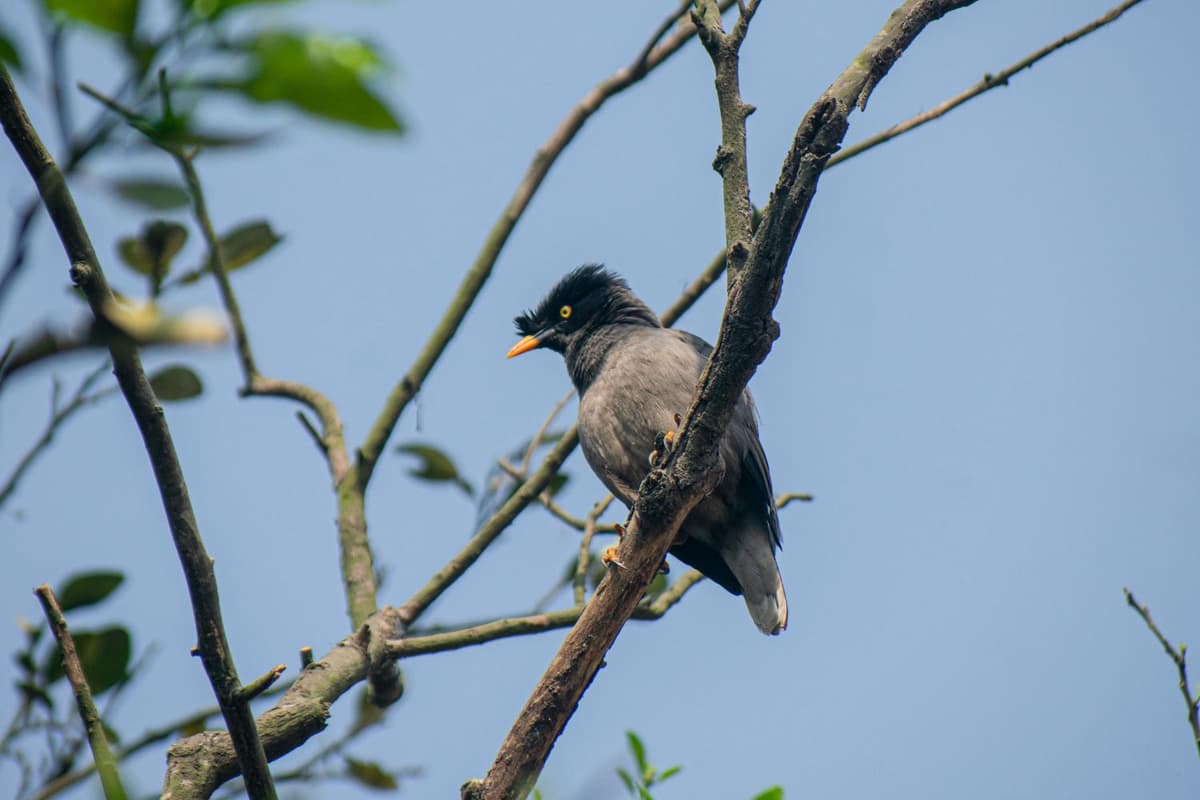
Perched on a branch, the myna scans its surroundings.
Common Myna in Vietnam
The Common Myna (Acridotheres tristis) is a native species found across the length of Vietnam, from the northern province of Lang Son down to Kon Tum in the Central Highlands. While they are occasionally seen in the North, they are much more common from the provinces of Nghe An and Ha Tinh moving southward. These birds prefer open landscapes and low-altitude areas, usually staying below 300 meters in places like Bach Ma National Park.
In Central Vietnam, specifically on the Son Tra Peninsula in Da Nang, the Common Myna thrives due to the protected environment. Here, they can be seen in massive, spectacular flocks of hundreds of birds. They are also officially recorded in northern nature reserves such as Cham Chu and Nam Xuan Lac, proving their ability to adapt to different regions of the country.
Myna Species at Cat Tien National Park
Cat Tien National Park is a paradise for birdwatchers, especially those interested in the Starling family (Sturnidae). While the Common Myna is a key resident, the park is actually home to seven other fascinating relatives. If you explore the open forests or areas near the park headquarters, you might spot these species:
- Black-collared Starling
- Great Myna
- Vinous-breasted Myna
- Hill Myna
- Golden-crested Myna
- White-shouldered Starling
- Chestnut-tailed Starling
The Common Myna thrives in Cat Tien National Park because of its incredible adaptability. This bird can live in many different environments, including tropical forests, open woodlands, and grasslands. Since Cat Tien offers a diverse tropical ecosystem with plenty of food and nesting spots, it is a perfect home for them. Additionally, because Common Mynas are comfortable living near humans, they often stay in areas where the park's nature and human activities meet.
Diet and Predators
Diet
The Common Myna is an omnivore, meaning it eats almost anything it can find. In the wild, insects are its most important food source, especially during the breeding season when parents catch crickets, grasshoppers, and caterpillars to provide protein for their chicks. In fact, its scientific name Acridotheres literally means "grasshopper hunter." Besides insects, they eat spiders, earthworms, small lizards, and even tiny snakes. They also enjoy fruits like figs, papayas, and mangoes, as well as flower nectar. Because they live near humans, they often scavenge for kitchen scraps, grains, and rice.
When keeping a Common Myna as a pet, providing the right balance is vital for its health. About 60% to 70% of its diet should be specialized low-iron pellets. These birds are very sensitive to iron, and too much can damage their liver. You should offer fresh soft fruits like bananas, melons, and pears for about 25% of their meal, but avoid citrus fruits like oranges because they help the body absorb too much iron. Small amounts of vegetables and protein, such as boiled eggs or mealworms, can be given a few times a week. Always avoid avocado, chocolate, and salty snacks, as these are toxic to the bird.
Predators
Even though Common Mynas are brave and aggressive birds, they face many natural enemies. In their native homes in Asia, they are hunted by tree-climbing mammals like civets and yellow-throated martens. Their nests, eggs, and chicks are often threatened by domestic cats, mongooses, and large crows. In some Pacific islands, humans also hunt them for food.
To protect themselves, Common Mynas have developed a smart defense behavior called "mobbing." When a predator is spotted, the birds emit loud, piercing alarm calls to alert others. They then gather in a large, noisy group to surround and harass the predator until it leaves the area. This teamwork helps keep the colony safe from animals that are much larger than an individual bird.
Common Myna Behavior
The Common Myna is a highly social and intelligent bird. They are known for being monogamous, often forming pairs that stay together for life. While they spend their days in small family groups, they gather in massive communal roosts at night, sometimes numbering in the thousands. These large gatherings help them stay safe from predators and exchange information about food sources.
On the ground, Mynas are easily identified by their confident "strut" or walk rather than hopping. They are also incredibly smart problem-solvers; they can remember human traps and warn their flock about specific enemies. However, they are also famously aggressive. In areas where they are invasive, they are known to kill the chicks of native birds or even small mammals like sugar gliders to steal their nesting hollows, earning them the nickname "flying rats."
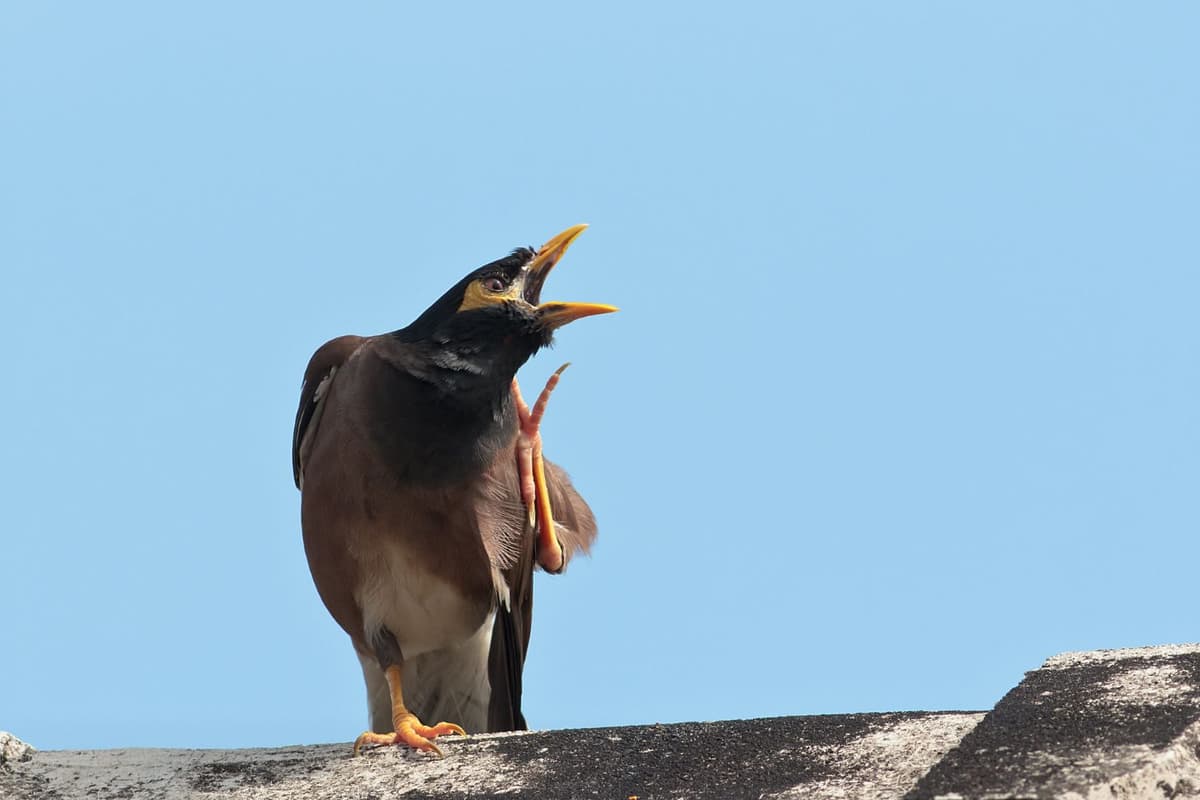
This myna shows aggressive behavior while calling loudly.
Myna Bird Talking
One of the most popular reasons people are fascinated by this bird is its ability to talk. This skill comes from a unique vocal organ called the syrinx, which allows them to produce two different sounds at once. Combined with a highly developed brain, Mynas don't just mimic by instinct. They listen and intentionally recreate sounds to get attention or food.
- Mimicry range: While they may not have the 100-word vocabulary of a Hill Myna, a Common Myna can learn between 10 and 30 human words. They are especially good at mimicking environmental noises like car alarms, whistles, and ringtones.
- Training tips: The best time to teach them is between 3 and 8 months old. Short, 15-minute sessions with cheerful repetition and food rewards work best.
- The "Tongue-cutting" myth: Contrary to some old myths, Mynas do not need their tongues cut or peeled to talk. This practice is cruel, ineffective, and can cause serious infections or permanent vocal damage.
Common Myna Calls and Sounds
The vocal world of the Common Myna is complex and loud. Their natural "vocabulary" includes a mix of croaks, squawks, chirps, and even growling noises. They use specific calls for different situations; for example, they have a sharp alarm call to warn of predators and a soft "trill" used by parents to tell chicks it is time to eat.
One of their most interesting habits is the "communal chorus" heard at dawn and dusk. Before sleeping, the entire flock sings together in a noisy, synchronized performance. Interestingly, Mynas living in loud cities have actually adapted their songs to a higher frequency so they can be heard over the low-pitched hum of traffic, a clear sign of their amazing ability to evolve alongside humans.
Reproduction of Common Myna
The Common Myna is a devoted, monogamous bird that typically forms life-long partnerships. Depending on the climate, their breeding season in Asia usually spans from March to September, during which a pair may raise up to 3 broods.
These birds are famous for their aggressive nesting habits; they fiercely compete for hollows in trees or man-made structures like roof vents and drainpipes, often evicting native birds to claim the space. Together, the pair builds a messy nest using twigs, roots, and even human trash like foil or plastic. Interestingly, they line the nest with green leaves to repel parasites and protect their future chicks.
The female lays 4 to 6 pale blue eggs, which both parents take turns incubating for about 14 days. Once hatched, the helpless, featherless chicks rely entirely on their parents. Because Mynas lack a crop to store food, parents must carry protein-rich insects like grasshoppers directly in their bills, signaled by a unique "trill" call. To keep the nest safe from predators, parents carefully remove waste and drop it far away. Young mynas fledge after 25 days but stay with their parents for another three weeks to learn essential survival skills before becoming fully independent.
Conservation and Invasive Impact
The Common Myna is classified as Least Concern (LC), with its global population growing rapidly. However, it is officially one of the 100 worst invasive species in the world. Originally from Asia, it has become a major threat in Australia, South Africa, and North America. In these regions, they are known for their extreme aggression, killing native chicks and stealing nesting spots from local birds and small mammals. They also spread diseases like avian malaria and help invasive weeds grow by dispersing seeds.
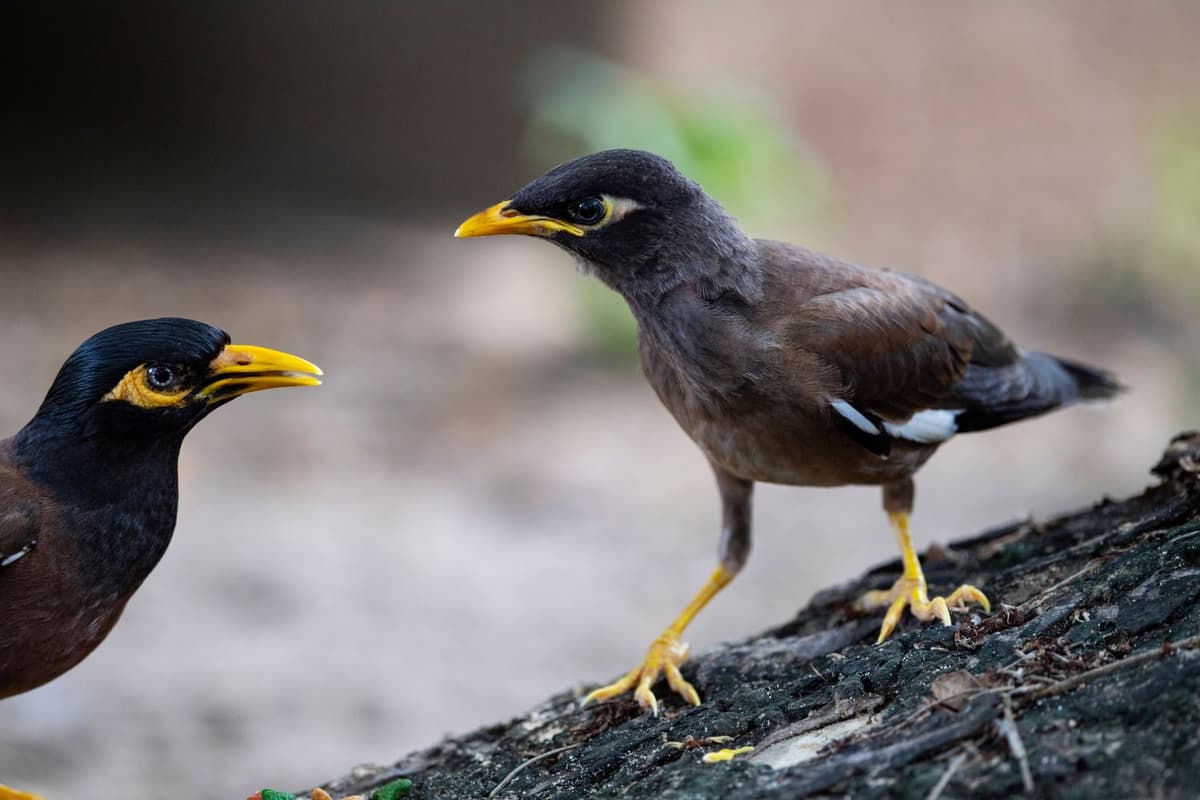
Two mynas stand close, showing social interaction.
Why They Are Considered Pests
Beyond nature, Mynas cause significant damage to human life. In agriculture, they destroy fruit crops like grapes and papayas. In cities, their massive, noisy flocks create pollution, and their droppings can spread Salmonella. They also carry bird mites that cause skin irritation and asthma in humans. Their habit of building messy nests in vents and electrical pipes even creates serious fire hazards, earning them the nickname "flying rats."
Keeping Mynas as Pets and Legal Status
While their intelligence makes them popular pets, Mynas require a very strict low-iron diet to avoid fatal liver disease. Legally, the rules vary:
- USA: Legal if captive-bred, but wild capture is banned.
- Australia & South Africa: Strictly controlled or illegal to prevent environmental damage.
- Vietnam: While native, capturing them from the wild for trade is illegal; owners must have legal proof of origin from a licensed breeder.
Common Myna Watching in Cat Tien National Park
Watching the Common Myna (Sáo nâu) at Cat Tien National Park is a rewarding experience for both casual nature lovers and dedicated birdwatchers. As one of Vietnam’s top birding hotspots, Cat Tien is home to nearly 400 bird species, making it a perfect place to observe this intelligent bird in its natural habitat.
The Common Myna is a resident species at Cat Tien and can be seen throughout the year. Unlike shy forest birds like the Pittas, the Myna is quite bold and often found in open areas. The best spots to find them include:
- Park headquarters: They are frequently seen around the main buildings and open clearings.
- Roadsides and riverbanks: Look for them perched on low branches or walking confidently along the paths near the Dong Nai River.
- Grasslands: They often follow large herbivores or park vehicles to catch insects stirred up from the grass.
The best time for observation is during the dry season (November to April), specifically in the early morning between 5:00 AM and 9:00 AM when birds are most active.
For a more personalized experience, you can join specialized tours. Katien Ranger Patrol offer small-group tours specifically designed for limited numbers of people. These tours allow for a quieter environment, which increases the chances of seeing more timid wildlife. You can also rent bicycles or take a jeep to the Crocodile Lake (Bàu Sấu) trail, where the landscape opens up, providing even more opportunities to spot Mynas and their colorful relatives.
5 Interesting Facts
- This intelligent bird is famous for its ability to mimic over 100 human words and environmental noises like sirens or phones.
- It is officially ranked among the top 100 worst invasive species in the world because of its negative impact on nature and farming.
- This species has a very distinctive and proud walking style on the ground instead of hopping like most other birds.
- The Common Myna builds messy nests using strange materials like paper or metal wires and sometimes even incorporates old snake skins.
- These birds stay with one partner for their entire life but will fight others very aggressively to protect a single nesting territory.
Reference
- Ali, W. (2021). Morphometric study of common Myna (Acridotheres tristis) in tehsil Havelian, district Abbottabad, KP Pakistan. International Journal of Applied Chemical and Biological Sciences, 2(3), 38–43.
- Anshu. (n.d.). Study of nesting behaviour in common myna (Acridotheres tristis). International Journals of Multidisciplinary Research Academy (IJMRA).
- Engel, I. F., Izhaki, I., & Charter, M. (2025). Effects of the invasive common myna (Acridotheres tristis) on nest site competition and predation in native birds. Biology, 14(7), Article 828. https://doi.org/10.3390/biology14070828
- Etayeb, K., et al. (2025). Breeding of the common myna, Acridotheres tristis Linnaeus, 1766 (Aves Sturnidae), in Libya: evidence of nesting and range expansion. Biodiversity Journal, 16(4), 593–596. https://doi.org/10.31396/Biodiv.Jour.2025.16.4.593.596
- Gameti, A., & Sengupta, S. (2025). A comparative account of calls of common myna in different human-influenced environments. Ecocycles, 11(1), 1–10. https://doi.org/10.19040/ecocycles.v11i1.465
- Grarock, K., et al. (2012). Is it benign or is it a pariah? Empirical evidence for the impact of the common myna (Acridotheres tristis) on Australian birds. PLoS ONE, 7(7), Article e40622. https://doi.org/10.1371/journal.pone.0040622
- Pyšková, K., Pyšek, P., & Foxcroft, L. C. (2022). Introduction and invasion of common myna (Acridotheres tristis) in Kruger National Park, South Africa. Biological Invasions, 24(8), 2291–2300. https://doi.org/10.1007/s10530-022-02790-x