Goats are remarkably adaptable mammals known for their sure-footed climbing, intelligence, and ability to thrive in harsh, rocky environments. Belonging to the genus Capra in the family Bovidae, goats include both wild species and the domestic goat (Capra hircus), one of the first animals humans domesticated around 10,000–11,000 years ago. Today, goats provide milk, meat, fiber (like mohair), and companionship worldwide, while wild goats like the markhor and ibex fascinate with their dramatic horns and extreme habitats.
From steep mountain cliffs to arid deserts, goats demonstrate extraordinary agility and resilience. Whether you're curious about goat breeds, wild mountain goats, or their role in conservation, this guide covers everything you need to know about these animals.
| Common name | Goat |
|---|
| Scientific name | Capra hircus |
|---|
| Taxonomy |
Kingdom: Animalia
Phylum: Chordata
Class: Mammalia
Order: Artiodactyla
Family: Bovidae
|
| Weight / Size | Weight: 20–140 kg (depends on breed). Body length: 68–100 cm. Shoulder height: 41–81 cm. Tail length: 3–8 cm. |
|---|
| Lifespan | Wild: 10–20 years. Captive: 12–18 years. |
|---|
| Population | Stable globally; some species endangered due to hunting and habitat loss |
|---|
| Habitat | Mountains, grasslands, forests, scrublands, and deserts; prefer open or semi-open landscapes |
|---|
| Range | Worldwide – Europe, Asia, North America, and introduced to Australia, South America |
|---|
| Diet | Herbivores: grasses, shrubs, leaves, flowers, twigs, and mosses |
|---|
| Conservation status | Least Concern (IUCN); some species are endangered (e.g., Walia ibex, Nubian ibex) |
|---|
Physical Characteristics of Goat
Adult goats vary greatly by breed. Shoulder height ranges from 41 to 81 cm, body length from 68 to 100 cm. Males are usually much larger than females. Weight typically falls between 20 and 140 kg. The smallest breeds, such as Nigerian Dwarf, weigh only 23–32 kg. The largest, like Boer goats, often exceed 136 kg, with some record individuals reaching 181 kg.
Goats have horizontal rectangular pupils that give wide side vision and reduce glare from above. They lack tear glands. Most have two horns made of bone covered in keratin. Horn shapes differ widely: backward-curved in ibex, corkscrew spirals in markhor, or straight in some mountain goats.
Tails are short and usually held upright or slightly curved, unlike sheep tails that hang down. The coat is hair (not wool, except in Angora goats that produce mohair). Colors include black, brown, white, spotted, or mixed patterns.
Both sexes can grow beards under the chin, more prominent in males. Some goats have wattles—two small fleshy flaps hanging from the neck. The mouth lacks upper incisors; instead, a hard dental pad on the upper jaw works with lower teeth to tear plants.
Hooves are cloven with hard outer edges for grip and soft inner parts for flexibility. Toes move independently, helping goats climb rough surfaces. Wild mountain goats have especially powerful shoulder and neck muscles for pulling themselves up steep rocks.
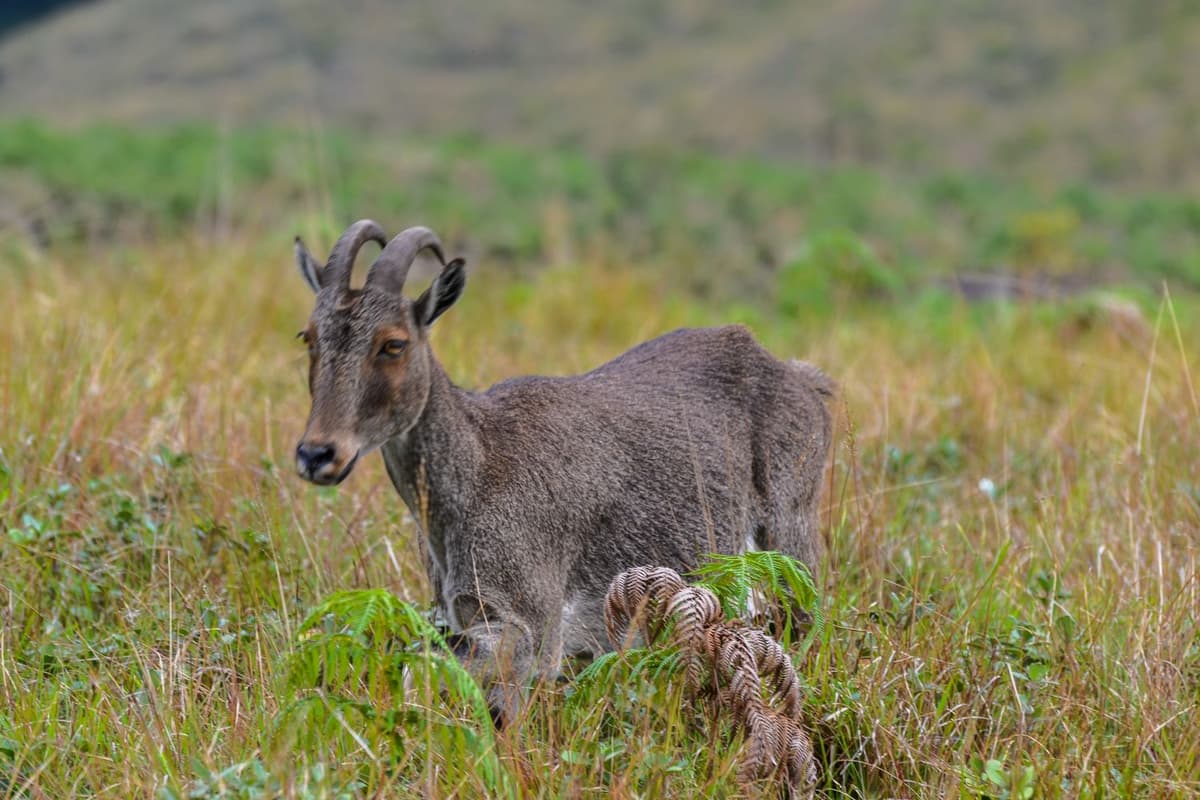
Goat appearance showing curved horns and sturdy body.
Subspecies of Goat
The genus Capra includes about 9–10 wild species plus domestic goats (Capra hircus, often viewed as a domesticated form of the wild goat Capra aegagrus).
- Markhor (Capra falconeri): Famous for long, spiraled horns; national animal of Pakistan.
- Walia ibex (Capra walie): Critically endangered; fewer than 250 mature individuals left in Ethiopia’s Simien Mountains.
- Nubian ibex (Capra nubiana): Vulnerable; about 4,500 mature individuals in Middle East and North Africa deserts.
- West Caucasian tur (Capra caucasica): Endangered; small populations in the Caucasus.
- Iberian ibex (Capra pyrenaica): Vulnerable or endangered depending on subspecies; some subspecies extinct.
Habit and Global Distribution
Habitat
Wild goats in the genus Capra, including mountain goats and ibex, are highly adapted to rugged, steep landscapes. They prefer high mountains, cliffs, rocky slopes, and limestone ridges where they can escape predators and find food. These habitats often sit at elevations from 1,800 to 3,300 meters, though some species live lower in tropical mountain forests.
Special adaptations help them thrive here. Flexible cloven hooves grip uneven surfaces, strong shoulder and neck muscles pull them up steep walls, and thick coats protect against cold. Some high-altitude species, like those on the Tibetan Plateau, have genes (such as EPAS1) for coping with low oxygen. Due to rising temperatures from climate change, species like the Alpine ibex are shifting to nighttime activity to avoid daytime heat.
Global Distribution
Globally, goat distribution varies by species.
- Mountain goats (Oreamnos americanus) are found only in North America, mainly in the Rocky Mountains, British Columbia, Alaska, and northwestern regions of the United States and Canada.
- Alpine ibex (Capra ibex) live in the Alps of Central Europe, including France, Switzerland, Italy, Austria, and Germany.
- Markhor (Capra falconeri) inhabit mountainous areas of South Asia, such as Pakistan, Afghanistan, and the Himalayas.
- Nubian ibex (Capra nubiana) occupy desert mountains in the Middle East and North Africa.
- Wild goats (Capra aegagrus) range across Southwest Asia, including Turkey, Iran, the Caucasus, parts of Eastern Europe, and Central Asia.
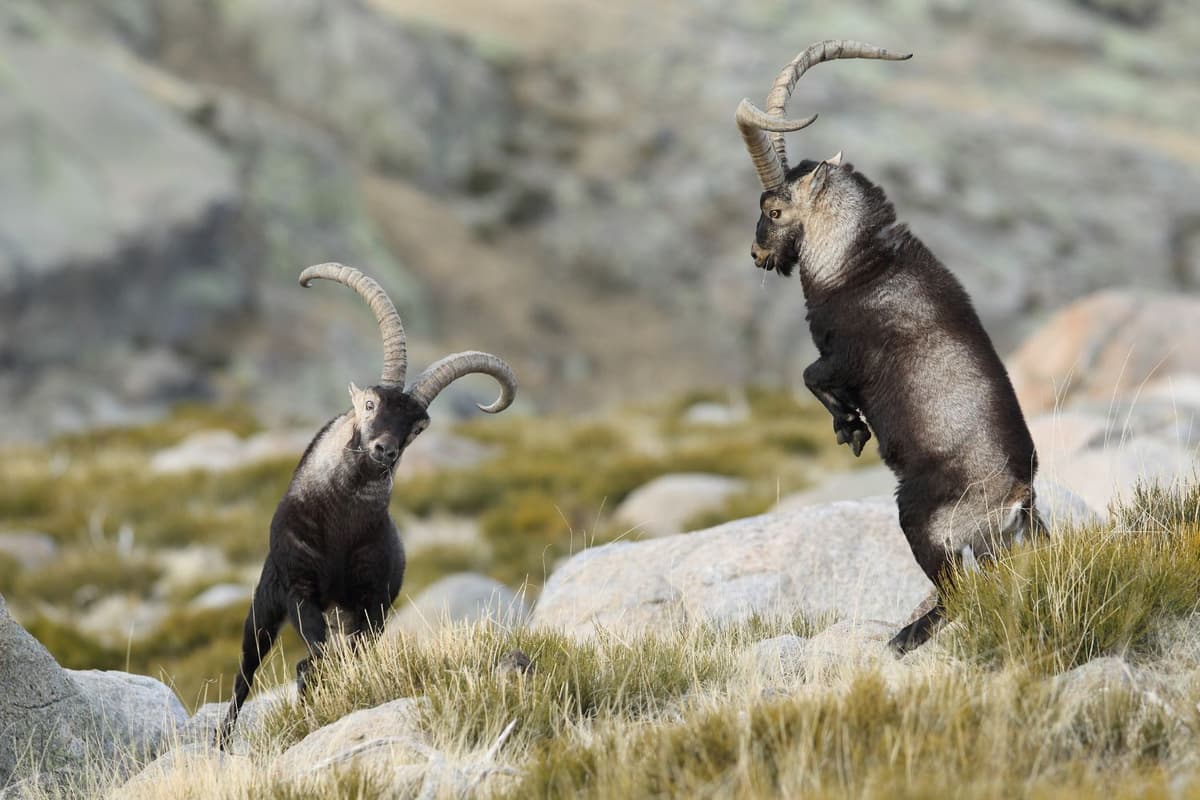
Iberian ibex standing on cliffs with strong balance.
Distribution in Vietnam
In Vietnam, no true Capra species exist. Local “dê rừng” or “sơn dương” refer to serow (Capricornis species), also called mainland serow or Indochinese serow. These once lived across northern mountains (Sơn La, Lai Châu, Cao Bằng, Lạng Sơn, Điện Biên, Hòa Bình) to central and highland areas (Quảng Bình, Quảng Nam, Đắk Lắk, Gia Lai, Kon Tum, Lâm Đồng).
Today they are very rare due to hunting and habitat loss. Small populations survive in protected areas such as Pù Luông, Cúc Phương, Bạch Mã, and Cat Tien (where they are uncommon), as well as border regions.
Diet and Predators
Diet
Goats are herbivores and primarily browsers rather than grazers. They prefer leaves, twigs, shrubs, herbs, flowers, mosses, lichens, and young shoots over short grass. In summer or growing seasons, they select tender alpine grasses, wildflowers, and new growth for maximum nutrition.
In winter or dry periods, they switch to woody twigs, conifer shoots, bark, dwarf shrubs, and lichens. Some species lower their metabolism to conserve energy during food shortages. Goats use sensitive lips to pick clean food and stand on hind legs to reach higher branches. They seek salt licks in spring to replace sodium lost from eating watery young plants. Their four-chambered stomach efficiently digests tough fibers.
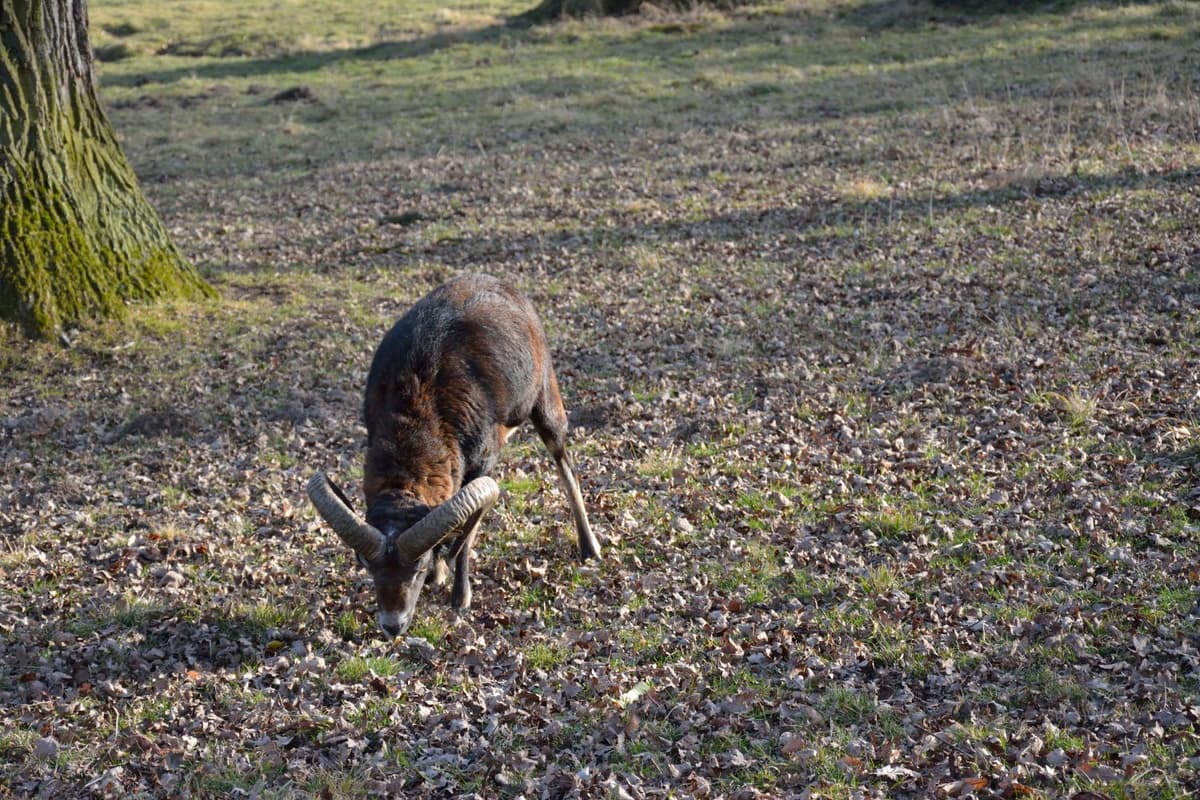
Goat eating grass in its natural habitat.
Predators
Natural predators include large carnivores such as cougars (mountain lions) in North America, wolves, brown and black bears, wolverines, lynx, leopards, tigers in Asia, and golden eagles that target young by knocking them from cliffs.
Goats defend themselves by living on steep, inaccessible terrain that predators find hard to navigate. They climb expertly and use sharp horns when cornered. Their excellent vision and high vantage points help them spot danger early. Young goats are more vulnerable than adults. Overall, population declines come mainly from human hunting rather than natural predators.
Habit and Behavior of Goats
Goats are exceptional climbers and movers. They scale near-vertical cliffs (slopes over 60 degrees) and even climb man-made structures like dams. Powerful shoulder and neck muscles pull their bodies upward, while they keep elbows close for balance. From the front, their slim profile helps them hug rock faces tightly.
Young goats zigzag up slopes and descend straight. Flexible cloven hooves spread for grip, soft inner pads act like climbing shoes, and sharp edges wedge into cracks. They leap up to 3 meters to cross gaps or reach ledges. Climbing steep cliffs is their main way to avoid predators like wolves, bears, and mountain lions. It also lets them access alpine grasses, lichens, and salt licks that other animals cannot reach. In winter, they choose slopes where snow slides off to expose food below.
Socially, goats separate by sex most of the year. Females (nannies) form stable groups of 5–10 with young. Males (billies) live in bachelor groups of 2–16 or alone, especially older ones. Dominance is based on size, age, and horn strength, reducing fights. Groups mix only during the breeding season (rut).
Goats are intelligent and good problem-solvers. Males urinate on their legs and beards to create scent that attracts females. Females eat their placenta after birth for nutrition and to hide the scent of newborns. In Morocco, domestic goats regularly climb argan trees to eat leaves and fruit.
Reproduction
Goats have a well-adapted breeding cycle suited to their rugged habitats. Breeding, or the rut, usually occurs in fall to early winter (October to December), with a peak in November. Males compete aggressively for females in a polygynous system, where one male mates with multiple females.
Females reach sexual maturity at 2–3 years of age (sometimes 2.5–4 years in wild mountain goats). Males mature earlier but only older, stronger individuals successfully breed. Gestation lasts about 5–6 months (147–186 days, averaging 150–180 days). Most births produce one kid, occasionally two, and rarely three. Females often leave the group to give birth alone on steep cliffs or rocky ledges to protect the newborn from predators.
Births happen in spring (May–June), when food is more available. Kids are precocial, they stand, walk, and follow their mother within hours of birth. Within a few days, they can climb alongside her. Mothers provide all care: nursing, teaching climbing and survival skills, and protecting the young fiercely. Kids nurse for 3–6 months and stay with the mother for at least one year or longer.
Goats have a low reproductive rate compared to other ruminants. This strategy helps them survive harsh environments but makes populations vulnerable to hunting or habitat loss. Domestic goats live 12–18 years (average 15 years). Wild and mountain goats typically live 10–20 years, depending on species and conditions.
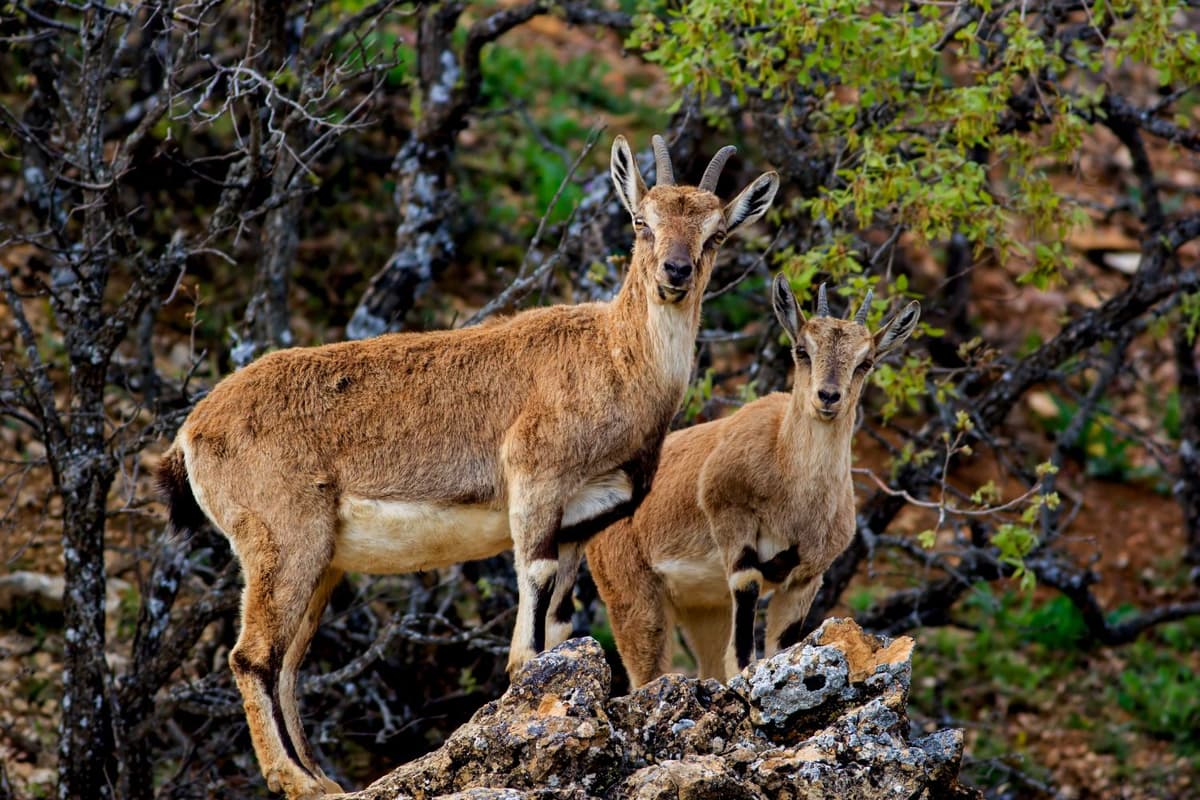
Two goats on the mountain, climbing steep rocky terrain together.
Threats and Conversation
Threats
Goats face multiple threats, both human-caused and natural.
Climate change is a growing problem: rising temperatures force mountain goats to shift activity to nighttime to avoid heat, increasing their risk from predators like wolves. Alpine habitats also shrink as forests expand upward.
Habitat loss comes from deforestation, competition with livestock for food, roads, and tourism development.
Domestic goats spread diseases and hybridize with wild populations, threatening genetic purity.
Poaching and illegal hunting target horns (especially markhor and ibex) and meat. This remains common in South Asia and the Middle East.
Diseases such as brucellosis and foot-and-mouth spread from domestic goats. Small populations suffer from inbreeding and genetic decline.
Natural threats include predators (wolves, bears, eagles) that target young, plus accidents like avalanches, cliff falls, and winter starvation.
Critically endangered species include the Walia ibex (under 250 individuals). Nubian ibex is vulnerable, and markhor is near threatened.
Conservation Efforts
Many goat species receive Least Concern status globally, but rare ones face high extinction risk. Legal protection includes hunting bans and national parks such as Gran Paradiso (Alpine ibex) and Simien Mountains (Walia ibex).
Community success stands out with markhor in Pakistan: local people manage controlled trophy hunting, share profits, and protect herds, leading to strong population recovery. Ongoing efforts involve annual population surveys, genetic data collection, climate monitoring, and IUCN status updates (Walia ibex now near Critically Endangered).
Other actions include protecting migration corridors, limiting human encroachment, and anti-poaching patrols by rangers and communities. Community involvement combined with strong legal measures has saved species like markhor. Continued action is essential to prevent extinction of critically endangered goats like Walia ibex.
Interesting Facts about Goats
- Goats have no upper incisors or canines. They use a hard dental pad on the upper jaw with lower teeth to tear and grind vegetation.
- Goats were one of the first animals domesticated by humans, around 10,000–11,000 years ago in Iran’s Zagros Mountains. Ancient bricks there still show goat hoof prints.
- In Morocco, goats are the only ruminants that regularly climb argan trees to eat leaves and fruit.
- Right after birth (kidding), goat mothers often eat their placenta. This provides essential nutrients, helps stop bleeding, and removes the birth scent to protect the newborn from predators.
Reference
- Alphonsus, C., Akpa, G. N., Barje, P. P., Nwagu, B. I., Orunmuyi, M., Sam, I. M., & Achi, N. P. (2017). Sexual dimorphism in morphological characteristics of two Nigerian indigenous goat breeds. Proceedings of the 42nd Annual Conference of the Nigerian Society for Animal Production, 94–96.
- Animal Health Australia. (2020). Australian industry welfare standards and guidelines for goats. Goat Industry Council of Australia.
- Fernandez, D. (n.d.). Using goats for brush control as a business strategy (FSA9604). University of Arkansas at Pine Bluff, Cooperative Extension Program.
- Harbsky, R. (n.d.). Overview of goat breeds and classification. Scribd.
- Hebert, D., & Cowan, I. M. (1971). Natural salt licks as a part of the ecology of the mountain goat. Canadian Journal of Zoology, 49, 605–610.
- Nitnaware, H. (2024, January 25). Mountain goats in Alps are turning nocturnal due to climate impact. Down To Earth.
- Zheng, Z., et al. (2020, May 20). The origin of domestication genes in goats. Science Advances, 6(21). https://doi.org/10.1126/sciadv.aaz5216
- Zhu, L., et al. (2025, February 27). EPAS1 variations and hematological adaptations to high-altitude hypoxia in indigenous goats. Animals, 15(5). https://doi.org/10.3390/ani15050695