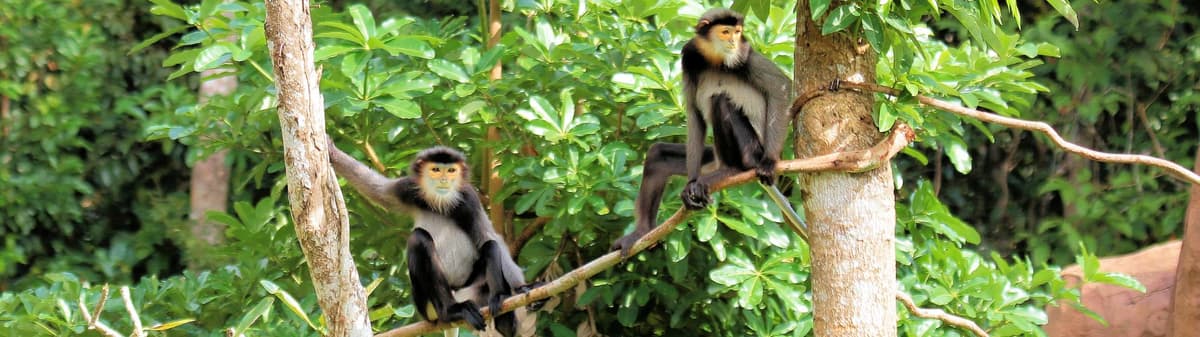
The black-shanked douc langur (Pygathrix nigripes) is one of the most colorful and endangered primates in the world. With its striking blue-gray face, bright eye rings, long white tail, and jet-black limbs, this arboreal "clown of the forest" leaps gracefully through the canopy of southern Vietnam’s tropical forests. Critically Endangered due to habitat loss and hunting, it survives in small groups, mainly in places like Cat Tien National Park.
At Katien Ranger Patrol, we help you experience this rare beauty through guided tours and live forest cameras. Read on to learn more about its unique features, habitat, behavior, and how we protect it.
| Common name | Black-shanked douc langur |
|---|
| Scientific name | Pygathrix nigripes |
|---|
| Taxonomy |
Kingdom: Animalia
Phylum: Chordata
Class: Mammalia
Order: Primates
Family: Cercopithecidae
|
| Weight / Size | Males: 8–11 kg. Females: 6–8.2 kg. Head-body length: 54–65 cm. Tail length: 65–85 cm (often longer than body). |
|---|
| Lifespan | Wild: ~24 years. Captive: >30 years. |
|---|
| Population | Fewer than 60,000–70,000 worldwide |
|---|
| Habitat | Tropical evergreen, semi-evergreen, mixed deciduous forests; middle to upper canopy |
|---|
| Range | Eastern Cambodia and southern Vietnam (east of Mekong River) |
|---|
| Diet | Strictly herbivorous: primarily young leaves, fruits & seeds, flowers |
|---|
| Conservation status | Critically Endangered (IUCN); CITES Appendix I |
|---|
Physical Characteristics of Black Shanked Douc
The black-shanked douc langur (Pygathrix nigripes) is a large arboreal primate and one of the bigger colobine monkeys. This species shows clear sexual dimorphism, with males noticeably larger and heavier than females.
Males weigh 8–11 kg (18–24 pounds), while females weigh 6–8.2 kg (13–18 pounds). The head and body length measures 55–65 cm in males and 54–60 cm in females, giving them a slender, graceful build. Their tails are very long—69–85 cm in males and 65–80 cm in females - often equal to or longer than the head and body. This long tail helps them balance while moving through the tree canopy.
The most striking feature is their completely black forearms and lower legs, which give the species its name "black-shanked." The back of the hands from the wrist to the elbow can be white in some individuals. The body fur is thick, soft, and smooth, with a dark gray or blackish-gray back and a lighter gray belly. The tail is white and slender, while the groin and rump areas show clear white patches.
Their face stands out with blue-gray or deep-blue skin, unlike that of other douc species. Around the eyes are bright cream, yellow, or orange rings that make the face look vivid. Facial hair includes short, sparse whiskers, reddish-brown fringes on the temples, and often a black forehead.
Males have a pale gray beard under the chin and along the jaw, which becomes longer and more obvious with age. Males also show a blue scrotum and pink or red penis, plus a round white patch on the rump with spots above it - features absent in females. Males tend to have darker, brighter faces than females.
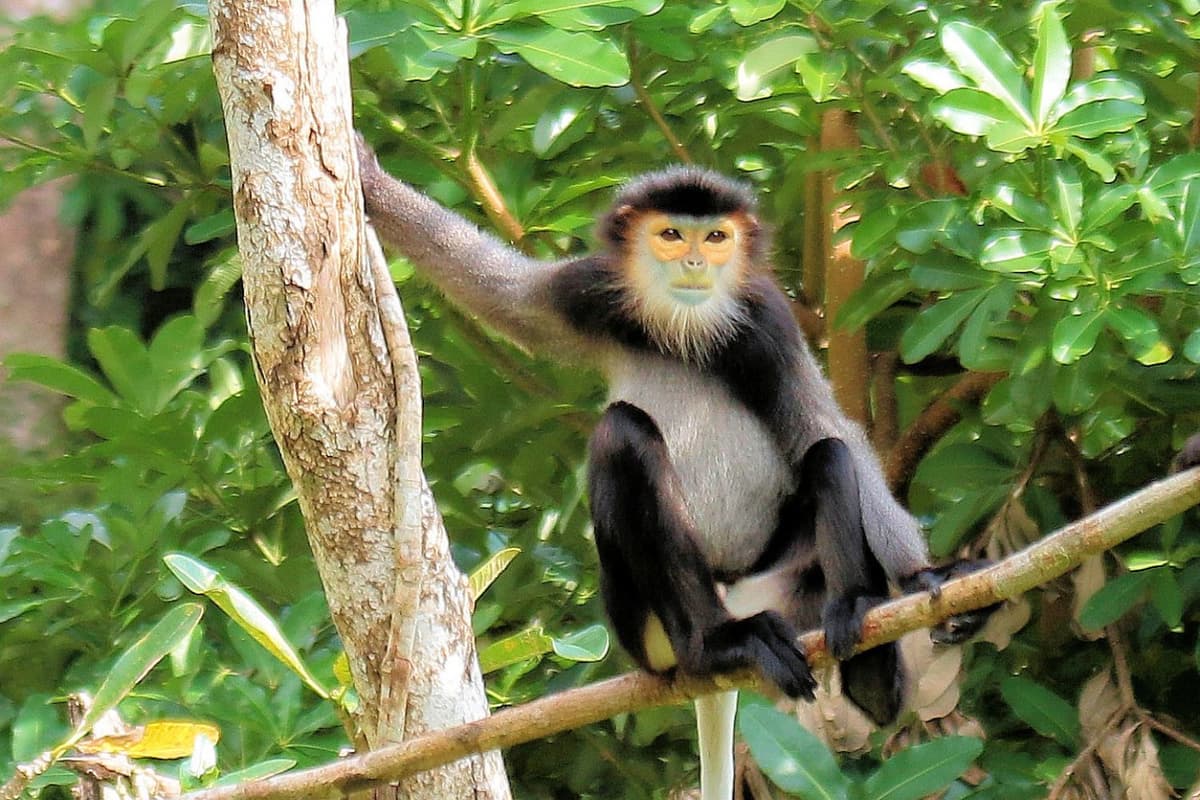
This striking primate balances gracefully on a forest branch.
Habitat and Distribution
Habitat
Black-shanked douc langurs live mainly in tropical forests and adapt to several forest types. They reach their highest densities in evergreen forests, where food and cover remain stable year-round. They also occupy semi-evergreen, mixed deciduous, dipterocarp, and even coastal forests.
They stay mostly in the middle to upper canopy layers and rarely come to the ground. At night, they sleep in tall, large trees to stay safe from predators and stay close to food sources. Their range spans from sea level up to 1,500 m, though most remaining groups now live at higher elevations because lowland forests have suffered heavy loss. They prefer primary or little-disturbed forests with big old trees and dense canopies for leaping and moving.
Global Distribution
This species is endemic to a small area in Indochina, found only in eastern Cambodia and southern Vietnam. The Mekong River forms a clear boundary; the langurs do not occur west of it. The largest global population lives in Mondulkiri Province, Cambodia, especially in the Seima Biodiversity Conservation Area (also called Keo Seima), with estimates around 25,000–42,000 individuals.
Range in Vietnam
In Vietnam, the range is more fragmented and smaller. It covers parts of the Southern Annamites and the southeastern regions. Confirmed provinces include Kon Tum, Gia Lai, Đắk Lắk, Đắk Nông, Lâm Đồng, Khánh Hòa, Ninh Thuận, Bình Thuận, Bình Phước, and Đồng Nai.
The largest Vietnamese population is in Núi Chúa National Park (Ninh Thuận), with about 700 individuals. Other key sites include Tà Kóu Nature Reserve (Bình Thuận), Bidoup - Núi Bà National Park, Chư Yang Sin National Park, and areas such as Bù Gia Mập, Hòn Bà, and Nam Nung. Total numbers in Vietnam are much lower than in Cambodia and continue to decline.
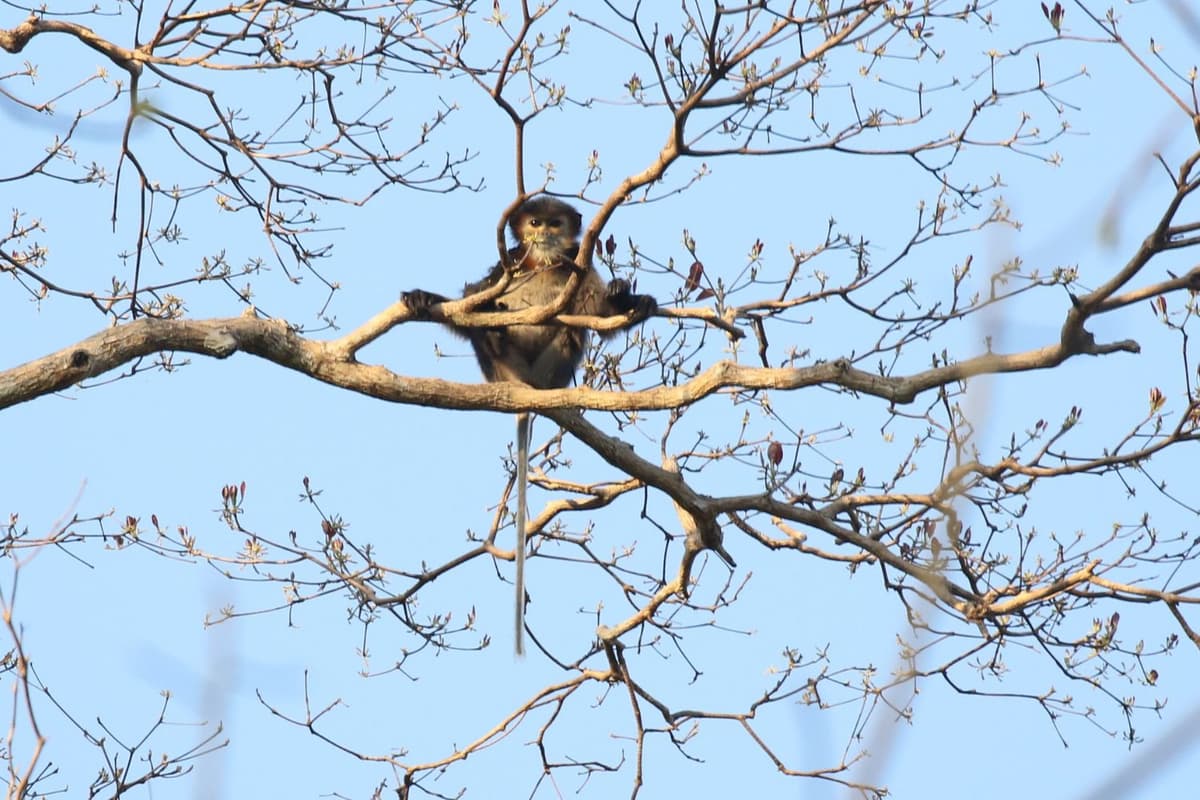
A lone douc sits on a bare branch against the blue sky.
In Cat Tien National Park
Cat Tien National Park (Đồng Nai Province) marks the southernmost limit of the black-shanked douc langur's range in Vietnam. The park supports important but modest populations living in semi-evergreen and mixed deciduous forests.
Thermal drone studies show that the langurs select tall, sturdy trees such as Afzelia xylocarpa (Gõ đỏ) for safe sleeping sites and proximity to food sources. The exact number of individuals in the park has not been precisely determined, but estimates suggest a modest population that forms only a small portion of the remaining total in Vietnam.
They coexist with other primates, including pygmy slow lorises, long-tailed macaques, pig-tailed macaques, silvered langurs, and yellow-cheeked crested gibbons. The park plays a vital role in ecotourism and ongoing conservation monitoring.
Diet and Foraging Habit
Black-shanked douc langurs are strictly herbivorous leaf-eaters with no intake of insects, eggs, or meat. Their main foods include young leaves, shoots, fruits (both green and ripe), seeds, and flowers.
Young leaves form the bulk of the diet because they are tender and nutrient-rich compared to mature leaves. Studies in southern Vietnam show leaves make up over half their intake. Fruits and seeds are also key, reaching about 40% in some Cambodian sites and similar levels in Vietnam, higher than in some related doucs. Flowers account for around 15%, especially during the dry season when blooms are abundant.
They select from over 150 plant species but favor certain favorites, often legumes. They get most water from leaves and fruits and rarely drink directly, though they sometimes descend to the ground for water.
Active during the day, they feed most in early morning (around 5–6 a.m.) and late afternoon (around 4 p.m.), resting at midday to digest. In places like Cat Tien, they pick tall trees for both safe sleeping and easy feeding, particularly in the dry season.
Social Structure and Daily Activity
Black-shanked douc langurs live in small groups led by one adult male, with several females and their young, typically seven or eight members. All-male groups and solitary males also exist. In the wet season, when food is plentiful, small groups often merge into larger bands of 20 to 50 animals, showing flexible social organization.
They are active by day, resting for long periods during the midday heat. Most feeding happens in the early morning and late afternoon, while travel and social activities take less time. Grooming is the main social behavior and helps strengthen group bonds, especially before resting or sleeping.
They travel mostly by walking on all four limbs along branches, with frequent leaps between trees and occasional arm-swinging. Compared to other doucs, they spend more time on the ground for moving or foraging.
When groups meet, males perform loud thigh-slapping or vigorous swinging displays to warn off rivals. Young animals show open-mouth play faces during fun, and a steady stare acts as a warning signal.
Infant care involves the whole group. Besides the mother, other females often carry and groom infants (allomothering), while adult males protect and sometimes play with the young.
Reproduction and Life Cycle
Female black-shanked douc langurs reach sexual maturity between 4 and 6 years of age, while males mature later, typically between 4 and 9 years. The mating system is polygynous: one adult male breeds with several females in his group.
Courtship usually begins with the female. She approaches the male, stares directly at him, juts out her chin, keeps her mouth closed, and shakes her head from side to side. If the male is interested, he replies with similar gestures, and mating follows. When a female is in estrus, her genitals become swollen and red, and the white rump area may temporarily turn reddish.
Gestation lasts about 6.5 months (roughly 180–200 days). Females normally give birth to a single infant. The time between births varies from 11 to 38 months, with an average of about 24 months in captivity.
Newborn infants have gray-blue faces that gradually become darker and more vividly blue as they grow. Mothers nurse their young for around one year before weaning.
In the wild, black-shanked douc langurs live about 24 years. In captivity, they can exceed 30 years. As they reach adulthood, both males and females usually leave their birth group to join another or form a new one. Young langurs play actively within the group and receive tolerant, protective care from the adults around them.
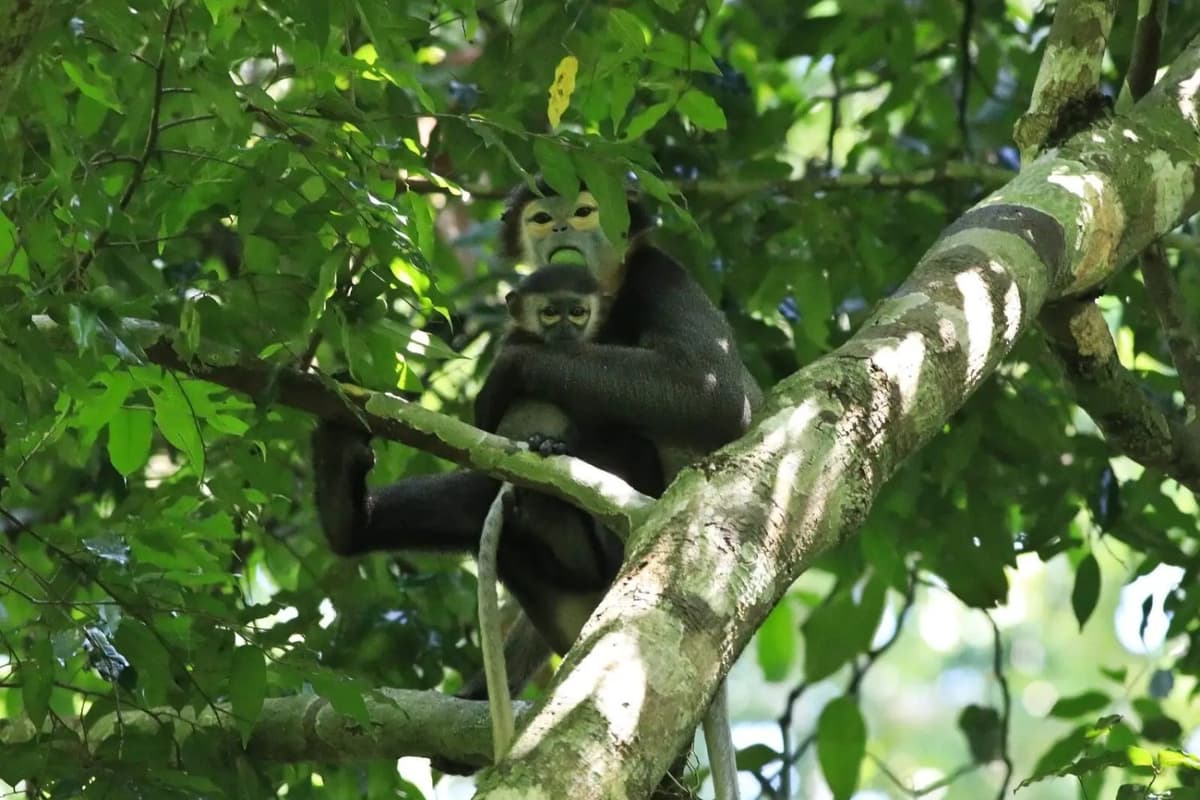
A mother and infant douc move carefully through dense foliage.
Threats and Conservation
Threats
Black-shanked douc langurs face predation from large raptors (such as eagles) and big cats (leopards and clouded leopards). They avoid danger primarily through camouflage and evasion rather than confrontation.
Upon detecting a threat, they freeze motionless and hide in dense foliage to remain undetected. They select tall trees with broad canopies for nighttime sleeping, making access difficult for ground predators. Group members issue loud, bark-like alarm calls to alert others.
However, the most severe threats stem from human activities. Hunting is the primary danger, targeting them for bushmeat, traditional medicine (stomach and bones), and capturing infants for the illegal pet trade. Wire snares remain widespread; for instance, over 3,300 were removed in a single year from Chư Yang Sin National Park.
Habitat loss and fragmentation compound the problem. Forests are cleared for rubber, coffee, and cashew plantations, illegal logging, roads, and hydroelectric dams, isolating groups and limiting movement.
Climate change presents a long-term risk: projections indicate that up to two-thirds of suitable habitat could disappear by 2070, potentially confining survivors to higher elevations like the Langbiang Plateau in Lâm Đồng Province.
Conservation Status and Efforts
The black-shanked douc langur is Critically Endangered on the IUCN Red List, having lost an estimated 50–80% of its population in recent decades. In Vietnam, it is listed in the highest protection category in the Vietnam Red Data Book and under Group IB, banning all hunting and trade. Globally, it is on CITES Appendix I, prohibiting international commercial trade.
Conservation includes drone surveys in Cat Tien National Park to map sleeping trees without disturbance, helping target protection zones. The Endangered Primate Rescue Center on Tiên Island (Cat Tien) rehabilitates confiscated animals, with special care for infants.
Cambodia’s Keo Seima Biodiversity Conservation Area holds the world’s largest population (25,000–42,000), but Vietnam’s fragmented groups remain vital for the species’ long-term survival. Strong anti-poaching, habitat protection, and community awareness are essential.
See Black-Shanked Douc Langurs in Cat Tien National Park
Cat Tien National Park is a key site for the black-shanked douc langur and marks the southern limit of its range in Vietnam. The langurs live mainly in semi-evergreen and mixed deciduous forests, where they prefer tall, sturdy trees such as Afzelia xylocarpa. These large trees provide safe sleeping sites above ground predators and reliable food sources, especially during the dry season.
Although numbers in Cat Tien are modest, the park supports specialized ecotourism tours focused on wildlife observation. The Endangered Primate Rescue Center on Tiên Island, located within the park, offers visitors an excellent educational opportunity to learn about the species, especially when wild sightings are difficult to see.
Tips for observing Black-Shanked Douc Langurs
- The best times to see black-shanked douc langurs are early morning (5–6 a.m.) and late afternoon (around 4 p.m.), when they are most active feeding.
- Avoid midday, as they rest quietly and hide in dense canopy foliage.
- From the ground, look for their distinctive black lower legs, blue-gray faces with bright eye rings, and long white tails hanging below branches.
- When people approach, they typically freeze and remain silent, blending into the leaves – often directly overhead but very hard to spot without careful scanning.
Katien Ranger Patrol is currently working with the Cat Tien National Park management board to offer small-group wildlife-viewing experiences, including potential sightings of rare species such as the black-shanked douc langur. These limited-access tours help minimize disturbance while maximizing opportunities for observation in sensitive areas.
For those unable to join in person, Katien Ranger Patrol has installed live camera systems deep in the park. These real-time wildlife cams stream activities from various forest spots, allowing remote viewing of animals such as deer, gaurs, civets, and occasionally primates.
Interesting Facts about Black Shanked Douc
- The black-shanked douc is the only douc with a distinctive blue-gray to deep blue face.
- They have a large, round "pot belly" from a multi-chambered stomach with bacteria that ferment and digest tough leaf cellulose, similar to cows.
- Extreme fear can trigger immediate diarrhea as a stress response.
- Some wild individuals show reddish leg fur like red-shanked doucs, but genetic tests confirm they are pure black-shanked, not hybrids.
- Females take the lead in mating: they stare, jut the chin, and shake the head to invite males, who reply if interested.
Reference
- Bailey, K., Winking, J., Carlson, D. L., & Long, H. T. (2025). Arm-swinging and habitat use of the red-shanked douc langur (Pygathrix nemaeus) in the Son Tra Nature Reserve, Vietnam. Folia Primatologica.
- Gazagne, E., Goldblatt, C., Trần, V. N., & Hambuckers, A. (2025). Utilizing thermal imaging drones to investigate sleeping site selection in an arboreal primate.
- Groenenberg, M., Crouthers, R., Yoganand, K., & Gray, T. N. E. (2023). Snaring devastates terrestrial ungulates whilst sparing arboreal primates in Cambodia's Eastern Plains Landscape. Biological Conservation.
- Gron, K. J. (2009). Primate factsheets: Douc langur (Pygathrix) taxonomy, morphology, & ecology, behavior, conservation.
- Hoang, M. D., Baxter, G. S., & Page, M. J. (2011). Preliminary results on food selection of the black-shanked douc langurs (Pygathrix nigripes) in Southern Vietnam. Vietnamese Journal of Primatology, 5, 29-39.
- Nguyen, T. A., & Le, D. M. (2025). Modeling potential distribution of the Black-shanked douc (Pygathrix nigripes). VNU Journal of Science: Earth and Environmental Sciences, 41(2S). https://doi.org/10.25073/2588-1094/vnuees.5407
- Tran, D. V., et al. (2020). Modelling the change in the distribution of the black-shanked douc, Pygathrix nigripes in the context of climate change. Raffles Bulletin of Zoology, 68, 769–778. https://doi.org/10.26107/RBZ-2020-0088
- Truong, T. T., et al. (2023). The population status of the black-shanked douc langurs (Pygathrix nigripes) in Nui Chua National Park, Ninh Thuan Province, Vietnam. Vietnamese Journal of Primatology, 3(4), 79-85.